
Australian liquid fuels
Australia’s liquid fuels system is essential to the economy but highly reliant on imports. There is an opportunity to strengthen Australia’s liquid fuel security by increasing domestic production and better utilising local refining capacity.
Current state of Australia’s liquid fuels system
Demand
Australia’s economy is highly dependent on liquid fuels, including diesel, petrol and jet fuel, which underpin transport, mining, agriculture, construction and defence.
- Liquid fuels represent over 40 per cent of Australia’s primary energy consumption, more than any other source.i Diesel in particular, underpins freight, mining and regional supply chains.
- In 2025, Australia consumed around 135 million litres of petrol and diesel per day, up from 55 million litres a day in 2015. Australia’s petrol and diesel consumption is higher today than any time in history.ii
- Road transport is the largest user of liquid fuels, accounting for 53 per cent of demand, followed by air transport (14 per cent), mining (13 per cent) and agriculture (4 per cent).ii
- While not a major consumer overall, the Australian oil and gas industry relies on diesel and jet fuel to transport workers and equipment and to power remote operations.
Production
Australia produces significant volumes of liquid fuels, including crude oil and condensate, although production is well below domestic demand.
- In 2025, Australia produced around 39 million litres of crude oil and condensate per day, down from 51 million litres per day in 2015.ii
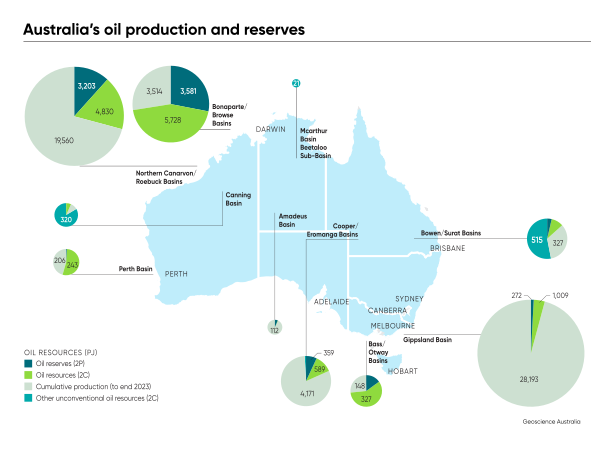
- Offshore Western Australia – including the Browse, Carnarvon and Perth basins – accounts for around 83 per cent of national crude oil and condensate production.ii
- The onshore Cooper-Eromanga and Surat-Bowen basins (South Australia and Queensland) produce around 8 per cent, while the Gippsland and Otway basins (onshore/offshore Victoria) contribute around 6 per cent.ii
Imports
Australia is a net importer of liquid fuels, with over 90 per cent of refined fuel consumption sourced from overseas.ii
- In 2025, Australia imported around 143 million litres of refined petroleum products per day, up from 87 million litres in 2015. Australia also imported on average 28 million litres of crude oil per day.ii
- Around 60 per cent of imports come from Singapore (22 per cent), South Korea (21 per cent) and Malaysia (17 per cent). Taiwan, India and Brunei contribute a further 20 per cent.ii
- Total imports of crude oil and refined products were valued at $53 billion in 2025.ii
Exports
While Australia is a net importer of liquid fuels, it also exports significant volumes due to the location of production and refinery specifications.
- In 2025, Australia exported around 40 million litres per day of crude oil and other refinery feedstocks and 13 million litres per day of refined products.ii
- Singapore is the largest export destination (20 per cent), followed by China (14 per cent) and South Korea (just over 6 per cent).ii
Refining
Australia’s refining capacity has declined from eight refineries in 2012 to two facilities today, the Ampol Lytton Refinery in Queensland and the Viva Energy Geelong Refinery in Victoria.
-
In 2025, Australia produced on average 38 million litres of refined products per day, down from 79 million litres in 2015.iii Petrol (41 per cent) and diesel (33 per cent) represent the majority outputs from Australian refineries.
-
Domestic refineries rely heavily on imported crude, while much of Australia’s production is exported. This reflects the geographic mismatch between west coast production and east coast refining, and the need to blend Australian crude with imported feedstock to meet refinery specifications.
-
In 2025, only 17 per cent of domestic refinery inputs were sourced from Australian production.iii
Storage
Australia maintains stocks of liquid fuels based on guidelines outlined by the International Energy Agency (IEA).
-
In 2025, Australia held around 50 days of net import coverage, rising to approximately 65 days when accounting for fuel in transit.iii
Opportunities to strengthen Australia's fuel security
Future production opportunities
Australia has a substantial resource base and several prospective basins that could support a material increase in liquid fuel production.
-
Australia has 17,142 million barrels (2,725 billion litres) of total demonstrated oil resources, including 1,312 million barrels (192 billion litres) of proven and probable (2P) reserves.iv
-
The Santos Dorado project and emerging basins such as the Taroom Trough and Beetaloo Basin could materially increase Australia’s oil production.
-
The Queensland Government has described the Taroom Trough as a potential “first major oil province in a generation.”v The Taroom Trough’s proximity to transport infrastructure and the Lytton refinery enhances its potential to support domestic supply.
Future refining opportunities
There is an opportunity to increase the share of Australian production refined domestically, strengthening fuel security over time.
-
In the near term, there may be opportunities to incrementally increase the use of Australian-produced crude in domestic refineries, depending on feedstock compatibility.
-
Over the longer term, the development of the Taroom Trough and other prospective basins could materially increase the volume of liquids available for domestic refining.
Recommendations
Key actions to increase Australia’s liquid fuel production and strengthen fuel security include:
-
Fast-track existing and near-term liquid fuel production by supporting increased production from existing fields.
-
Increase domestic processing of Australian production where viable, by improving refinery logistics and flexibility to process a wider range of feedstocks, including facilitating road tanker access and handling capability, and exploring alignment between domestic production and refining capability.
-
Accelerate development of new projects and basins, including the Dorado project and Taroom, through streamlined approvals, stable, competitive regulatory settings and strengthened pipeline infrastructure between emerging basins, refineries and demand centres.