


Taxes and Royalties
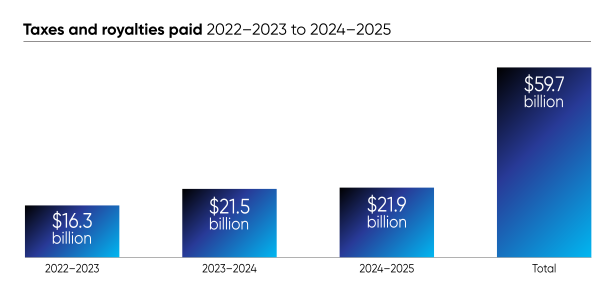
$21.9 billion
In taxes and royalties paid in 2024-25
Equivalent to annual cost of the PBS
$59.7 billion
In taxes and royalties paid in the last 3 years
of company tax in Australia comes from oil and gas companies
Australian Taxation Office figures show that the Australian oil and gas industry is the second biggest corporate tax-paying sector in Australia.i
The industry paid an estimated $21.9 billion in taxes and royalties in 2024–25 to state and federal governments, which helps pay for schools, hospitals, roads and essential services.ii
To put this contribution in perspective, that is equivalent to the annual cost of funding the Pharmaceutical Benefits Scheme (PBS).iii
The Australian Taxation Office has confirmed that “some oil and gas companies [are] now amongst the largest taxpayers in Australia”.iv
Over the past three years alone, the sector has paid almost $60 billion in taxes and royalties, reaffirming the industry’s substantial and ongoing contribution to the Australian economy.
Frequently asked questions
Does the gas industry pay enough tax?
Yes. The Australian oil and gas industry is Australia’s second largest corporate taxpaying sector.
In 2024-25 the gas industry paid $21.9 billion in taxes and royalties – equivalent to the annual cost of the Pharmaceutical Benefits Scheme (PBS).
The industry pays a range of state and Commonwealth government taxes, royalties and levies, which helps governments pay for schools, hospitals, roads and essential services.
What is the difference between taxes and royalties?
The location of a petroleum (oil and gas) project determines whether it is liable to pay royalties to a state or territory government, or a production-based tax to the Australian Government.
For projects located in Commonwealth waters, the Australian Government’s Petroleum Resource Rent Tax (PRRT) applies, whereas onshore projects are liable to pay royalties to the state or territory government where they are located.
Why don’t companies pay more in PRRT?
PRRT is just one of several taxes and levies the oil and gas industry pays. It operates in place of a state royalty scheme and only applies to projects in Commonwealth waters.
Treasury estimates gas companies will pay $5.4 billion in Petroleum Resources Rent Tax (PRRT) over the next four years to 2028–29.v
PRRT only applies once a project has recouped development and eligible costs — which takes many years for capital-intensive projects like LNG facilities.
Why do other countries collect more tax from their gas operations?
Comparisons with other countries ignore fundamental differences between their tax and resources operations.
Countries like Norway and Qatar have significant direct government ownership and/or investment in their oil and gas sectors, which means the government takes on more of the risks and shares more in the returns.
These countries also provide their oil and gas sector with generous support and tax breaks. For example, Norway provides an annual cash refund up to the value of 71.8% for exploration costs in order to reduce investor risk and encourage more oil and gas exploration and development.vi
In contrast, countries like Australia and the United States require private companies to assume the considerable financial risk of oil and gas development.
Additional resources
Citations
i ATO, Corporate Tax Transparency 2022-23, November 2024
ii Australian Energy Producers Financial Survey, July 2025
iii Budget 2025–26, Department of Treasury, March 2025
iv ATO, Corporate Tax Transparency 2022-23, November 2024
v 2025–26 Mid-Year Economic and Fiscal Outlook, December 2025
vi The Petroleum Tax System, Norwegian Petroleum, October 2024